
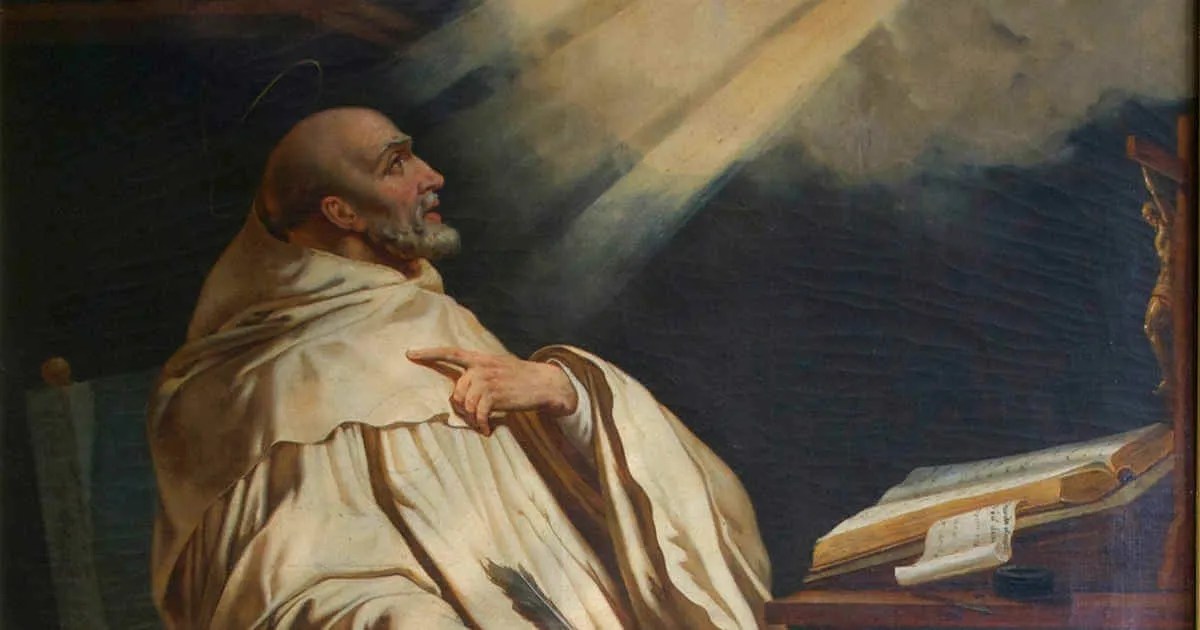
Angelo’s Patron Saint
St.Bernard of Clairvaux
“You wish me to tell you why and how God should be loved. My answer is that God himself is the reason he is to be loved.”
THE LAST OF THE CHURCH FATHERS
Bernard of Clairvaux was born in 1090 in Fontaines, Burgundy, into a noble family of faith and learning. From his earliest years he was marked by an unusual depth of soul, a sensitivity to spiritual things that set him apart even among the devout. By his early twenties, he had not merely entered the Cistercian monastery at Cîteaux, he had brought thirty other men with him, including his own brothers and his widowed father. That was the kind of man Bernard was: he did not walk into a room quietly.
In 1115, at just twenty-five years of age, he was sent to found a new monastery in a harsh, remote valley that would become Clairvaux, meaning Valley of Light. From that valley, over the next four decades, Bernard became arguably the most influential voice in all of Christendom. Popes sought his counsel. Kings deferred to his judgment. Theologians either allied with him or reckoned with him. He founded over sixty monasteries. He wrote with a pen dipped equally in fire and honey.
Historians have called him the last of the Church Fathers, a man who stood at the hinge of the ancient and medieval world and held the door open for the Holy Spirit to move through it. He was canonised in 1174 and declared a Doctor of the Church in 1830. His feast day is the 20th of August.
“There are those who seek knowledge for the sake of knowledge, that is curiosity. There are those who seek knowledge to be known by others, that is vanity. But there are those who seek knowledge in order to serve, that is love.”
– St. Bernard of Clairvaux
A THEOLOGIAN OF GRACE AND LOVE
At the heart of Bernard’s theology was a conviction that still rings true across nine centuries: that the knowledge of God is inseparable from the love of God. His masterwork, On Loving God, is not a cold systematic treatise, it is a devotional and theological meditation that burns with personal affection for Christ. Bernard wrote not as a scholar admiring a subject, but as a man ravished by a Saviour.
He described four degrees of love, from loving oneself, to loving God for His gifts, to loving God for God’s own sake, and finally, the highest, most mysterious degree, loving even oneself only for the sake of God. That progression is not a ladder of achievement. It is a description of what grace does to a soul over time. It transforms. It reorients. It makes a person less self-centred not by self-effort, but by sustained encounter with the love of Christ.
His sermons on the Song of Solomon, eighty-six of them, spanning decades, remain some of the most extraordinary meditations on the intimacy between Christ and the believer ever written. Bernard saw in that ancient love poem the very heartbeat of the gospel: that God does not merely tolerate His people. He loves them. Passionately. Tenderly. Without reserve.
THE SIMPLICITY OF CLAIRVAUX
For all his influence, Bernard lived simply. The Cistercian rule was one of austere beauty, plain stone, plain song, plain bread, and long hours of silence in the presence of God. Bernard believed deeply that the excess and ornamentation creeping into the Church of his day was not merely an aesthetic problem. It was a spiritual one. When the trappings of wealth and power become the language of ministry, the still small voice of Christ gets drowned out.
He famously wrote a stinging rebuke of the lavish decoration of certain monasteries, asking why the poor should go without bread while church walls were covered in gold. That was not the anger of a cynic. It was the grief of a man who loved the Church too much to watch her lose her way. Bernard’s simplicity was not asceticism for its own sake, it was devotion. It was the clearing away of everything that stood between the soul and its Saviour.
THE VOICE THAT WOULD NOT BE SILENT
Bernard was not a man who looked away when error entered the room. When the brilliant and controversial theologian Peter Abelard began teaching doctrines that Bernard believed undermined the sufficiency of Christ’s atonement and the mystery of divine grace, Bernard confronted him, not with personal malice, but with the full weight of theological conviction. He pursued the matter to the Council of Sens in 1140, where Abelard’s teachings were condemned. Bernard was not universally loved for it. He was called aggressive, even ruthless. But he carried the reproach as a man who believed the truth of the gospel was worth the cost of conflict.
He confronted antipopes. He wrote to kings. He challenged the corruption of clergy without flinching. And through all of it, his letters reveal not a power-hungry ecclesiastical politician, but a man who was constantly on his knees, exhausted, sometimes ill, longing to return to the silence of Clairvaux, and yet compelled by love for Christ and His Church to keep speaking.
That is the Bernard I recognise. Not the triumphalist. The tired, faithful, grace-saturated man who could not stop telling the truth about Jesus.
WHY BERNARD IS MY PATRON SAINT
There are connections in life that you can only explain as the deliberate handwriting of God. This is one of them.
I, Angelo, was born on the 20th of August. That is the feast day of St. Bernard of Clairvaux. And my middle name, given to me at birth, is Bernard. Long before I had ever read a word he wrote, long before I understood what a patron saint was or what grace theology meant, God had already written this man’s name over my life. My parents gave me the name. God had ordained the connection. I am only now beginning to understand the weight of it.
To share a name with Bernard of Clairvaux is not something I carry lightly. This was a man for whom the name of Jesus was not merely theological vocabulary, it was breath. He wrote that the name of Jesus is “honey in the mouth, melody in the ear, a shout of gladness in the heart.” That is the kind of devotion I aspire to. Not the devotion of performance or platform, but the devotion of a man so undone by grace that the name of Christ becomes the most natural word on his lips.
And like Bernard, I have known what it is to confront teaching that empties the cross of its power. When Keziah and I walked out of a community that had taken years and resources from us, that answered sincere questions about Jesus with silence and cursed us at the door on our way out, I needed a witness from history that this kind of confrontation was not bitterness dressed up as theology. Bernard was that witness. He showed me that a man can love the Church with his whole heart and still refuse, absolutely refuse, to let false teaching go unanswered. That faithfulness is not aggression. It is love, the most costly kind.
Grace Culture Church carries his spirit in that sense, not his era, not his method, but his refusal to be silent where Christ is being displaced by something lesser. My name is Angelo Bernard Peterson Pullenayegam and I was born on his feast day. I did not choose this patron. He was chosen for me, long before I had the wisdom to choose well for myself. And for that, I am grateful beyond words.
HIS PRAYER, MY PRAYER
Bernard died on the 20th of August, 1153, at the age of sixty-two, worn out, by most accounts, by a lifetime of giving more than his body had to give. He had not built an empire. He had not accumulated. He had poured himself out for Christ and for the people Christ loved, and when there was nothing left to pour, he went home.
That is the kind of end I would be honoured to make. Not famous. Not comfortable. Just empty, in the best possible way, having given what was given to me, for the glory of the One who gave it.
 Grace Culture Church - Grace Changes Lives