
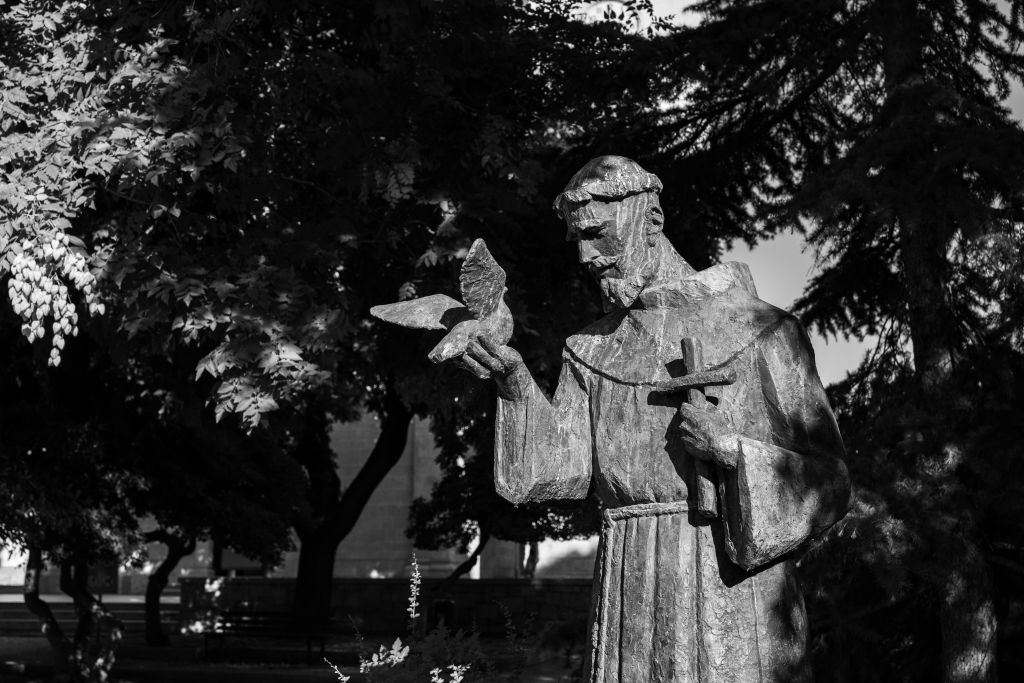
Our Patron of Inspiration
St.Francis of Assisi
“Preach the gospel at all times. When necessary, use words.”
THE MAN WHO GAVE EVERYTHING BACK
Giovanni di Pietro di Bernardone – known to the world as Francis of Assisi, was born in 1181 in the Umbrian hill town of Assisi, Italy, to a wealthy cloth merchant. By every outward measure, he had what the world called success: prosperity, social standing, the future of a comfortable life spread before him. He even rode to war with the ambitions of a young knight.
But God had other plans. Through illness, imprisonment, and a series of encounters that cracked open his heart, Francis heard the voice of Christ, most famously in the crumbling church of San Damiano, where he believed he heard the Lord say: “Francis, go and repair my church, which as you see is falling into ruin.” He began with stones and mortar. He ended up rebuilding something far greater.
In one of the most striking acts of his life, Francis stood before his father and the bishop of Assisi, removed his fine clothing, handed it all back, and walked away with nothing. He chose the life of a beggar for Christ, owning nothing, fearing nothing, needing nothing beyond the grace of God. He called himself Il Poverello, the little poor man. And from that poverty, he became one of the most spiritually wealthy figures in the history of the Church.
“Lord, make me an instrument of your peace. Where there is hatred, let me sow love. Where there is injury, pardon. Where there is doubt, faith. Where there is darkness, light.”
– The Peace Prayer of St. Francis
WHAT FRANCIS MEANS TO US
We dedicate this page to St. Francis not because we follow every tradition that surrounds his name, but because his life speaks a language we recognise, the language of someone who was stripped of everything by the world, and found in that stripping the beginning of true freedom in God.
Angelo and Keziah know something of what it means to have things taken, finances, time, energy, years. And like Francis, what they discovered on the other side of loss was not bitterness but grace. Francis did not leave his father’s house cursing the wealth he had known. He left it with open hands and a lighter heart. That posture, open-handed, grace-rooted, walking forward without the weight of what was lost, is the posture we aspire to at Grace Culture Church.
Francis also understood that the Church is always in need of renewal. He did not abandon the faith of his fathers, he loved the Catholic Church deeply, but he heard the call to something more alive, more radical, more rooted in the actual person of Jesus Christ. That same call echoes through the Reformation and into our own day. It is the call we have answered in planting Grace Culture Church: not to protest the Church, but to build it up, one life, one heart, one encounter with grace at a time.
THE MAN WHO PREACHED TO BIRDS AND VICTORIA
One of the most beloved and enduring qualities of St. Francis was his deep, tender reverence for all living creatures. He called them his brothers and sisters. He preached to birds. He negotiated, legend has it, with a wolf. He saw in every creature a reflection of the Creator’s glory, a living sermon on the goodness and imagination of God. The natural world was not, to Francis, merely scenery. It was a sanctuary.
We think Francis would have had a great deal of affection for Victoria, our Labrador Retriever, and a thoroughly beloved member of our household. There is something about a dog that embodies, without any theology degree, the very things Francis preached: loyalty without conditions, joy without reservation, presence without pretence. Victoria does not know the word grace, but she practises something very close to it every single day.
She is a reminder to us, in the middle of ministry demands and the busyness of life, that God fills the world with small, warm, tail-wagging mercies. Francis knew this. We are still learning it. Victoria is a patient teacher.
HIS LEGACY, OUR PRAYER
Francis of Assisi died on the evening of 3 October 1226, asking to be laid on the bare ground as a final act of humility before God. He was forty-four years old. He had founded an order, inspired a movement, written hymns to creation, and demonstrated to a medieval world, and to every world since, that a person fully surrendered to Christ is the most free, most joyful, most alive kind of person there is.
That is the life we are after at Grace Culture Church. Not celebrity. Not comfort. Not the applause of a crowd. Just the freedom of people who have been found by grace, set free by grace, and sent out by grace, to love the world the way Francis did: recklessly, humbly, and with open hands.
 Grace Culture Church - Grace Changes Lives